
In The Beginning
It all started many thousands of years ago when a small “ca” seed met a larger “cao” seed and they fell in love. The resulting “cacao” is the basis for all the chocolate we eat today.
Okay, we made that up. Did we mention we’re not historians? Obviously there’s no way to know exactly how and when the cacao tree actually began but scientists believe it evolved about 10 million years ago. The first evidence of cacao use dates from approximately 5,300 years ago by the Mayo-Chinchipe civilization in Ecuador. Traces of theobromine (a chemical compound in cacao) have been found in their pottery, suggesting cacao was first used in a drink. This is a relatively recent discovery – up until 2018 it was believed that the earliest cacao use was about 4000 years ago by the pre-Olmec peoples of what is now Mexico.
It makes sense that a civilization in South America was the first to use cacao since cacao originated in the Amazon basin, an area which still contains the largest genetic diversity of cacao. Scientists theorize that over the years various cacao genomes traveled along the Amazon and developed into the distinct genetic varieties we find today. This genetic diversity is one of the primary reasons different cacao beans have such wildly different flavors. We have the Amazon to thank for much of the flavor diversity of single origin cacao.
On The Move
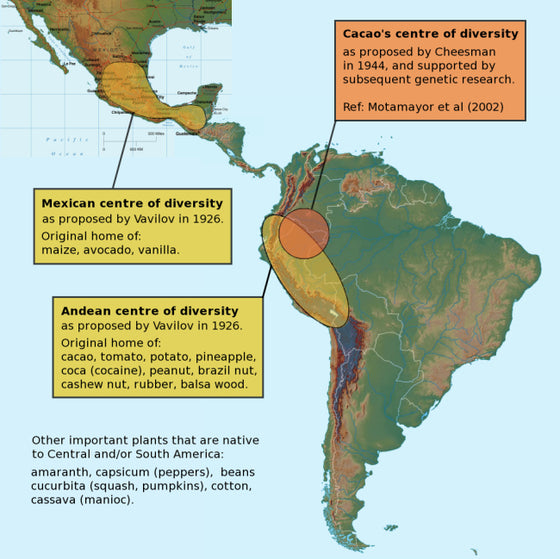
From its origins in the Amazon basin of South America cacao traveled to Southern Mexico (which is technically North America) where it was used first by the pre-Olmec peoples, then the Olmecs, the Mayans and the Aztecs.
But, how did it travel all that way? Probably in several different ways. It’s believed the beans were brought by boat from South America to the western coast of Mexico, into the area that is now Soconusco. It’s also very likely that cacao beans moved north naturally, carried by weather patterns as well as birds and other animals.
Evidence from pre-Olmec (4000 BC – 1500BC) and Olmec (1500 BC to 400 BC) pottery suggests these civilizations used cacao in a drink, primarily for religious purposes. How cacao was used in these times is often quickly passed over in histories of cacao, mainly because neither of these civilizations had a written history. It isn’t until the rise of the Mayan civilization, which did have a written history, that more is known about how cacao was prepared and used.
Xocolatl is Born
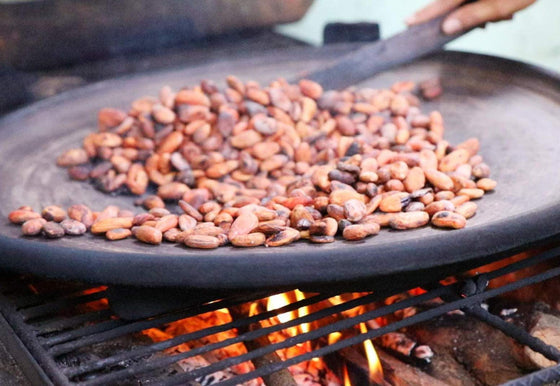
Mayan civilization spans thousands of years, beginning around 2000 BC. Cacao was an integral part of their culture, and was used not only in religious ceremonies but also as a way to entertain, a way show off status and wealth, and as currency. One way to show status was with a drink made from cacao known as “xocolatl,” which translates to “bitter water.” Although there isn’t consensus on this point, it’s likely this is where we got the word “chocolate. To prepare xocolatl the cacao beans were briefly fermented, sun dried and then (usually but not always) roasted on a hot plate over a fire. The husks were removed and the beans were then ground into a paste using a “metate,” which consists of a curved stone baseplate and a stone roller. The beans were crushed between the two to form a paste. The paste was then added to water and locally available flavorings would be added depending on the taste of the maker – various flowers, pimienta gorda (allspice), vanilla, maize, chili powder, etc.
Cacao was also valued as an important commodity, as well as a religious and status symbol, in the Aztec Empire, which began to flourish around 1345 CE. The Mayans and the Aztecs had a robust trade, and cacao was highly valued. The Aztecs continued the tradition of xocolaltl, adding their own flavorings and documenting its use in religious and other ceremonies. The drink was prepared by pouring the hot mixture back and forth from vessel to vessel to create a froth, which was an important part of the presentation – the more froth the better. Perhaps most famously, “xocolatl” was served frequently in the court of Montezuma, who ruled the Aztec Empire from 1502 (or 1503, depending on who you ask) to 1520. This is the time when Europeans first stumbled upon cacao.
Enter the Europeans
Perhaps not surprisingly Christopher Columbus was the first European to come in contact with cacao beans (or, at least, was the first to document it). The story is pretty true to form: On August 15th, 1502 he robbed a Mayan trading ship near Honduras and took their cacao. He knew the beans were important because, in his words, “They seemed to hold these almonds at a great price; for when they were brought on board ship together with their goods, I observed that when any of these almonds fell, they all stooped to pick it up, as if an eye had fallen.”
Although Columbus realized the beans were valued by the Mayans, he didn’t understand that these “almonds” would soon also be prized by Europeans.
The pivotal moment for cacao expanding to Europe came in 1519 when Hernan Cortes arrived in the Aztec Empire. In the Aztec capital city of Tenochtitlan he saw xocolatl being served as a ceremonial beverage in court of the Montezuma. He also saw the Aztecs using cacao beans as currency. Realizing this meant money could literally be grown on trees he promptly established a cacao plantation.
Cortes’ subsequent brutal treatment of Montezuma and the Aztecs is well documented, and the actions of the Spanish invaders is what began the downfall of the Aztec empire. For a great history of what really happened between Montezuma and Cortes we recommend “When Montezuma Met Cortes: The True Story of the Meeting That Changed History.”
For the purpose of our brief cacao history, suffice it to say that Cortes returned to Spain in 1528 with cacao beans and xocolatl making equipment, such as metates. He also added sugar to the xocolatl recipe, which made it much more palatable to Europeans. Over time the name is changed “Chocolate,” which is easier for Europeans to pronounce, and cinnamon and nutmeg are added as flavorings. Chocolate in drinking form then becomes hugely popular with the Spanish elite.
Chocolate Conquers the World
In the late 1500’s and early 1600’s the drink began to spread more widely across Europe, and in the 1650’s it reached England. The first English chocolate house opened in 1657, and soon chocolate houses were almost as widespread and popular as coffeehouses. Drinking chocolate was made from blocks of solid cocoa, which were most likely imported from Spain.
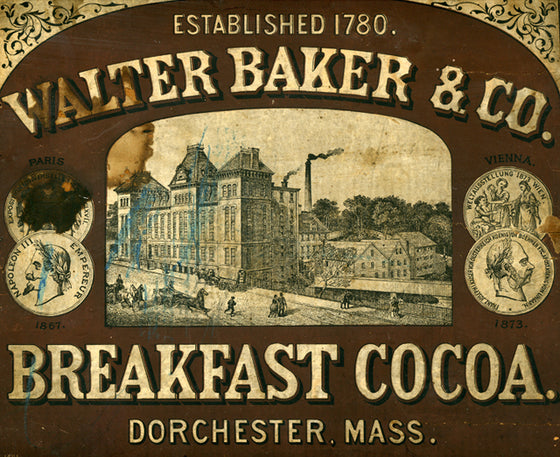
Around 1700 the English added milk to the drink. Then, in 1764 drinking chocolate came to the Americas – two men in New England, John Hannon and Dr. James Baker, started importing cacao beans and producing chocolate in Dorchester, Massachusetts. Their factory made solid cakes of chocolate which were used for making chocolate drinks.
The original brand name was “Hannon’s Best Chocolate,” but that changed in 1779 when John Hannon went missing on a cacao purchasing trip and his wife sold his share of the company to Dr. Baker. The company had various owners (including James Baker’s son, Walter Baker) until 1927 when it was bought by the Postum Cereal Company, which became General Foods, which was acquired by Kraft foods in 1989. Kraft Heinz still sells unsweetened chocolate under the Baker’s name.
The evolution of chocolate from primarily being consumed in drinking form to being eaten in solid form occurred due to several innovations during the 1800s.
In 1828 Casparus van Houton created cocoa powder by separating cocoa butter from cocoa solids. This is important because it’s one of the main factors that allowed cost-effective, mass-market, production-line creation of chocolate bars later on. That same year van Houten’s son Coenraad invented “dutching,” or alkalizing. Alkalizing removes many of cacao’s beneficial flavanols, as well as the natural flavor of the beans, so it’s never something we do when making our chocolate. But for large companies looking to create a consistently flavorless product to which they can add their own flavors, it’s perfect. The process also makes the cacao less acidic, which simplifies the manufacturing process.
Then in 1847 J.S. Fry and Sons created the first chocolate bar suitable for mass production. This bar was still very different than the chocolate bars we know today – it was coarse and bitter, primary because the crucial process of conching hadn’t been invented yet. Joseph Fry was also the first to introduce factory production techniques, using a Watt steam engine to grind the cacao beans.
In 1875 Daniel Peter and Henry Nestle invent milk chocolate, which quickly gained in popularity. Cadbury and Fry’s soon begin making milk chocolate as well.
But the pivotal invention that made the chocolate bar as we know it today possible was invented in 1879 by Rodolphe Lindt. Known as a conche for the original machine’s resemblance to a conch shell, this machine affects the chocolate in several important ways. It releases acids and other volatile compounds so that the chocolate is less acidic, promotes flavor development, and allows the cocoa butter to completely enrobe the cacao solids, giving the chocolate a smooth texture.
After the conche was invented chocolate companies began using it to make chocolate bars. In 1893 Milton Hershey came across conche machines for the first time at the World’s Columbian Exhibition in Chicago, and bought two of them on the spot. Hershey’s chocolate, and the mass market chocolate industry in the United States, was born.
For almost a hundred years large scale factory manufacturing was the sole method by which chocolate was made. Mass market producers like Cadbury, Nestle and Hershey purchased large amounts of cacao beans from West Africa at extremely low prices, without any real emphasis on quality or flavor. The reason quality and flavor aren’t important to them is because the beans are processed so heavily, and so many additives are used, that the quality and flavor of the beans don’t really matter.
In the mass market factory process the cocoa butter is separated from the cocoa solids, then sold to the cosmetics industry as it’s worth more than it would be in chocolate bars. The remaining cocoa solids are then alkalized to remove all the natural flavors (as well as many of the healthy polyphenols). Then soy lecithin is added, along with sugar and, in the case of milk chocolate, milk powder. Finally, in most cases synthetic vanillin (made primarily from crude oil) is added to give the resulting processed substance some flavor. Mass market chocolate bars made in this way don’t taste at all like the cacao beans from which they’re made, and sometimes have a cacao content of as little as 11%.
Needless to say these mass market bars are more of a “processed chocolate food product,” than actual chocolate. It’s to “real” chocolate what Velveeta is to real cheese. The flavor is monotone, reflecting the additives and not the flavor of the beans from which the chocolate was made, and it contains very little of the healthy polyphenols for which dark chocolate is known. But, that’s just about the only type of chocolate that was available until the early 2000s.
When this all changed is arguable, but it could be said that the first chocolate company to focus on premium chocolate was Dagoba, in 2001. Around 2006 (the same year Dagoba was bought by Hershey) a number of small craft chocolate companies were founded, which began focusing on single origin chocolate – buying beans directly from small farmers and focusing on the unique flavors of the beans from different regions.
So, what brought about this focus on flavor and direct sourcing after over one hundred years of mass-market chocolate products? One reason was a growing awareness of the inequities in the cacao supply chain. Large chocolate manufacturers have a long history of underpaying for their cacao, locking farmers into a cycle of poverty and creating an environment in which forced labor and even slave labor can exist. Small chocolate makers like ourselves saw an opportunity to compensate farmers fairly, and to raise awareness of the many issues with the cacao supply chain in the hope that by setting an example we could help effect positive changes on a larger scale.
Another reason is that small farmers and cooperatives were beginning to increase the quality of their post-harvest processes, such as fermenting and drying. These two processes are critical to flavor development, so this allowed the flavors in beans from specific regions to really shine through.
Since the mid-2000’s single origin craft chocolate has been gaining more and more recognition. There are many reasons for this, with the unique and incredible flavors playing a large part. Small farmers in not only North, Central and South America but also Africa and Southeast Asia are increasingly producing fine flavor cacao with the help of non-profits, NGOs and other organizations that are providing technical assistance to help with harvest and post-harvest techniques to raise the quality of the cacao they’re producing. This high quality cacao commands a premium price from specialty chocolate makers and helps encourage other farmers to become involved.
So, contrary to a very common misperception craft chocolate isn’t a return to an “original” or “pure” way of making chocolate. Chocolate started as a drink, then evolved directly into a mass-market, additive-laden bar. It wasn’t until fairly recently that there was a recognition that chocolate is a food, and not just a candy, with different types of beans having different flavors in the same way that wine grapes do.
Now that you know the basics of the history of cacao we encourage you to explore it in more detail. There are many good books out there and we highly recommend starting with “Raising the Bar: The Future of Fine Chocolate,” which details the rise of craft chocolate and reasons behind its growth.
Thanks for taking the time to read – we hope you learned some interesting facts about chocolate. To try our award-winning chocolate bars for yourself visit our Online Store!
Be sure to check out our “Fine Cacao” page to learn how we turn our fine flavor cacao beans into chocolate!